
Buying Guides
Advantages and Disadvantages of Different Screw Types
Briefly introduce the advantages and disadvantages of different screw
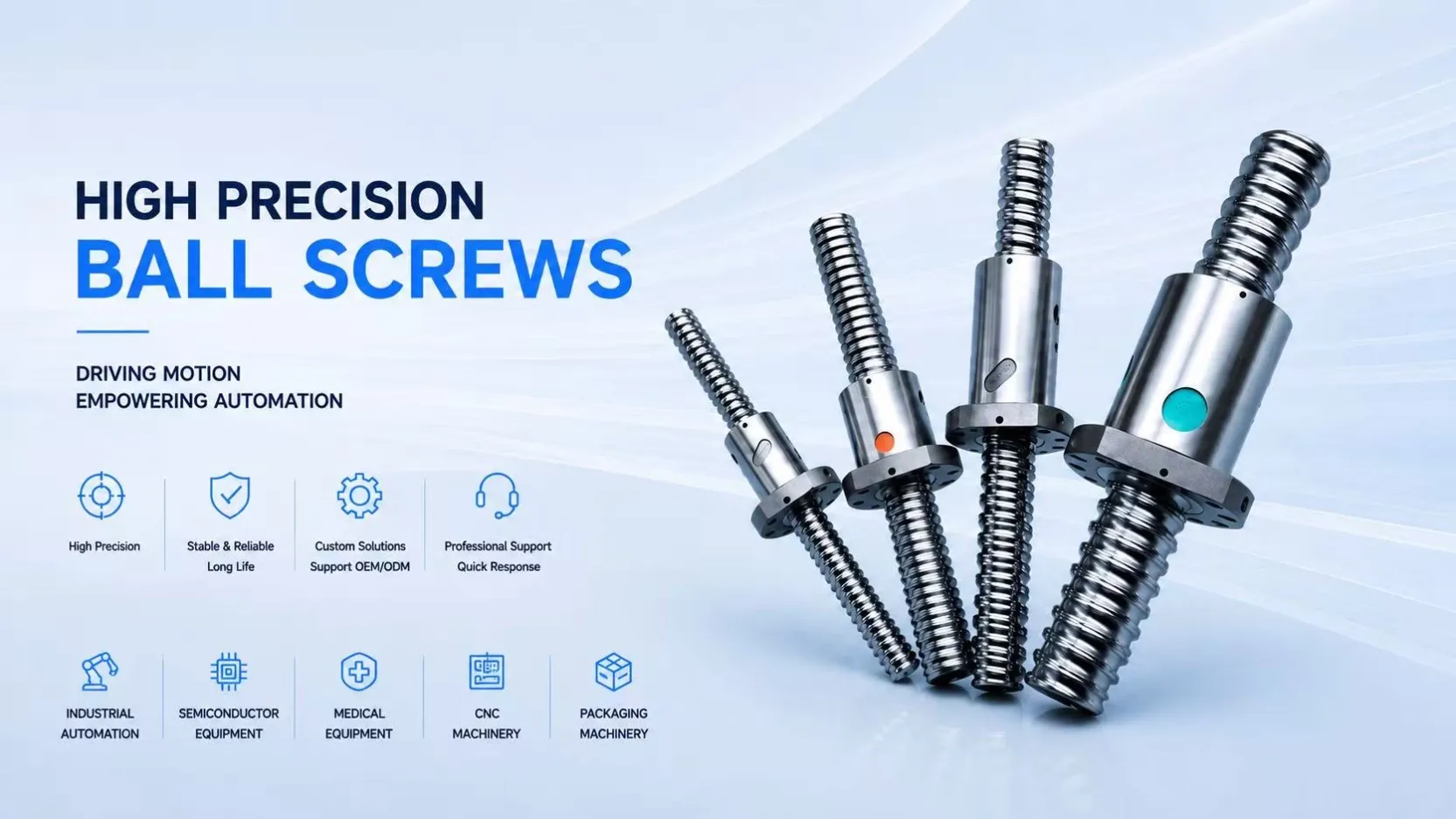
Screws are essential components in linear motion systems. They convert rotary motion into linear movement and are widely used in automation industries.
Understanding the dvantages and disadvantages can help you select the most suitable solution for your application.
1.Trapezoidal Lead Screws
✅ Advantages
- Simple structure, low cost
- The friction pair can achieve self-locking (when the lead is small, it won't slide down when installed vertically, and no brake is needed)
- The nut can be made of copper, plastic, PEEK, and can be treated for corrosion prevention, and can be used in dusty and dirty environments
- Easy to process, can be cut to length as needed, and maintenance is simple
❌ Disadvantages
- Sliding friction, low efficiency (30% - 45%), high heat generation, not suitable for long-term continuous high-speed operation
- Fast wear, the gap increases over time, and the accuracy retention is poor
- Easy to crawl at low speed, positioning accuracy is average
- Under the same size, the load-bearing capacity is lower than that of ball screws
2.Rolling Ball Screw
✅ Advantages
- Rolling friction, high transmission efficiency (around 90%), low heat generation
- Can be pre-tightened to eliminate clearance, good repeatability
- Can operate at high speed, much longer lifespan than trapezoidal screws
- Can be mass-produced, with quick delivery time and high cost-effectiveness
❌ Disadvantages
- Not self-locking. The vertical axis must be equipped with a brake
- The steel ball circulation structure is prone to dust and debris, requiring a dust-proof cover
- The accuracy is average, unable to reach ultra-high precision level
Grinding ball screw
✅ Advantages
- Extremely high lead accuracy, good surface roughness, and high rigidity
- Capable of achieving micron-level positioning with high stability
- Low friction, suitable for precise continuous motion
❌ Disadvantages
- High manufacturing cost
- Long production time (usually 30-60 days)
- Non-self-locking, requiring high environmental cleanliness standards
The next article will introduce the commonly used accessories that go together with the screw rod.